Finding the first step
Opening guidance needed work.
Design responseTutorials, language access, and contextual help.
CASE STUDY 05 / 2026 Loom
Testing a digital-continuity concept to understand how clarity, consent, and authenticity shape trust.
Discover the story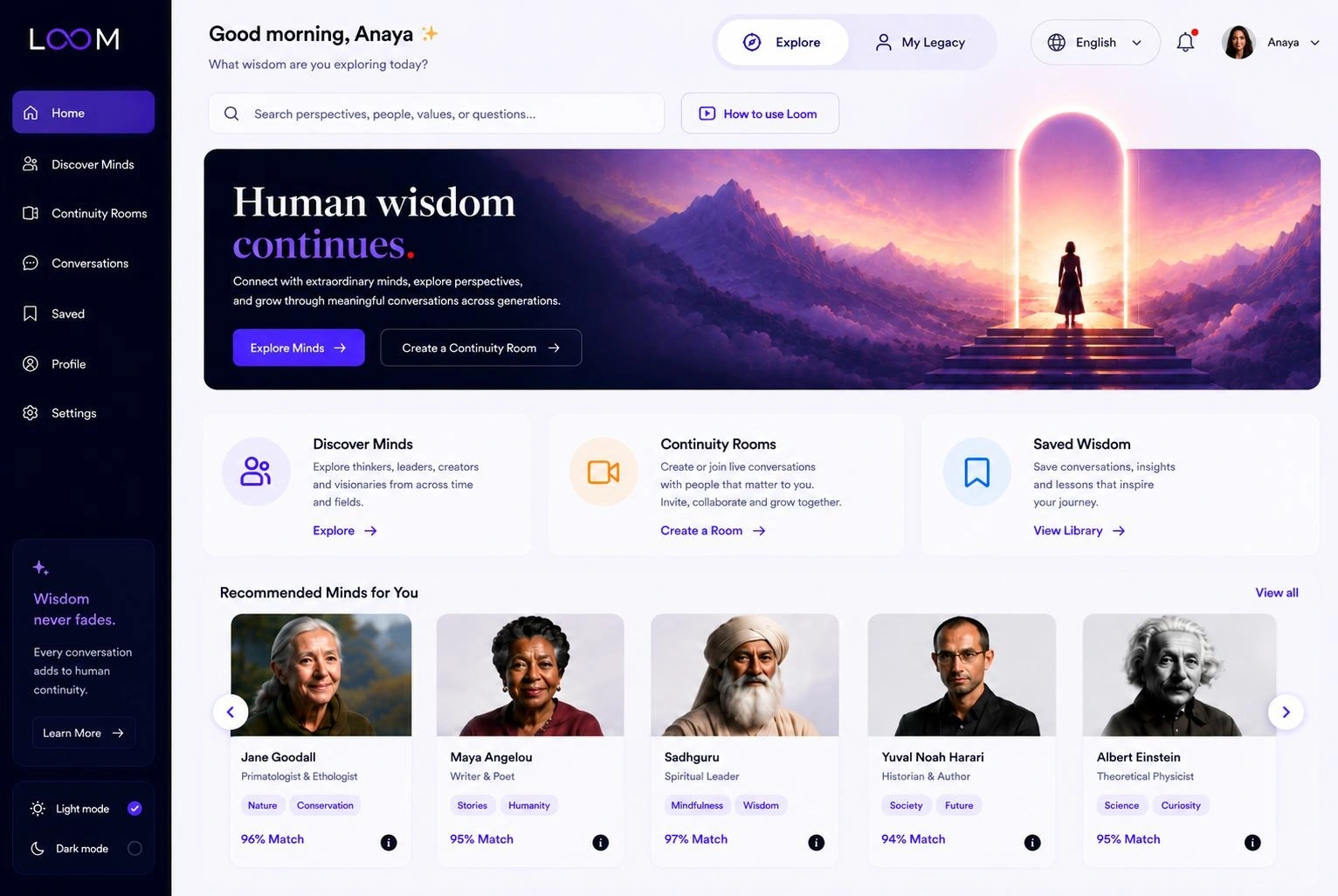 Loom USER TESTING · DIGITAL LEGACY · PROTOTYPING
A digital-continuity interface concept. Testing examined clarity, authenticity, and control.
01 / THE QUESTION
Loom explored how people could preserve knowledge, stories, and ways of thinking for future dialogue. This prototype study examined concept clarity, navigation, emotional response, and the controls participants needed around authenticity and legacy.
SCAD · DMGT 720 · Spring 2026 · Collaborative concept project · Part 4: Testing, Feedback & Iteration
Moderated usability testing · Think-aloud tasks · Interviews · Iterative prototyping
Collaborative concept testing, feedback synthesis, and iteration.SCAD DMGT 720 · Research, synthesis, and prototype development credited collaboratively.
02 / THE RESEARCH
Seventeen participants took part from May 16–18, 2026: nine Continuity Seekers and eight Legacy Architects. Sessions lasted 30–40 minutes and mixed in-person and online participation. The study explored concept clarity, navigation, emotional response, and whether the experience resonated differently across the two groups.
Continuity Seekers completed moderated prototype tasks, with think-aloud feedback, journey mapping, and interviews. Legacy Architect sessions were more flexible and conversation-led, adapting to participants’ different relationships with knowledge, identity, and legacy while keeping the learning goals consistent.
QUALITATIVE FEEDBACK → DESIGN PRIORITY
Opening guidance needed work.
Design responseTutorials, language access, and contextual help.
Group flows introduced hidden conditions and unclear steps.
Design responseVisible scheduling, personal notes, and a useful recap.
Participants wanted transparency and control.
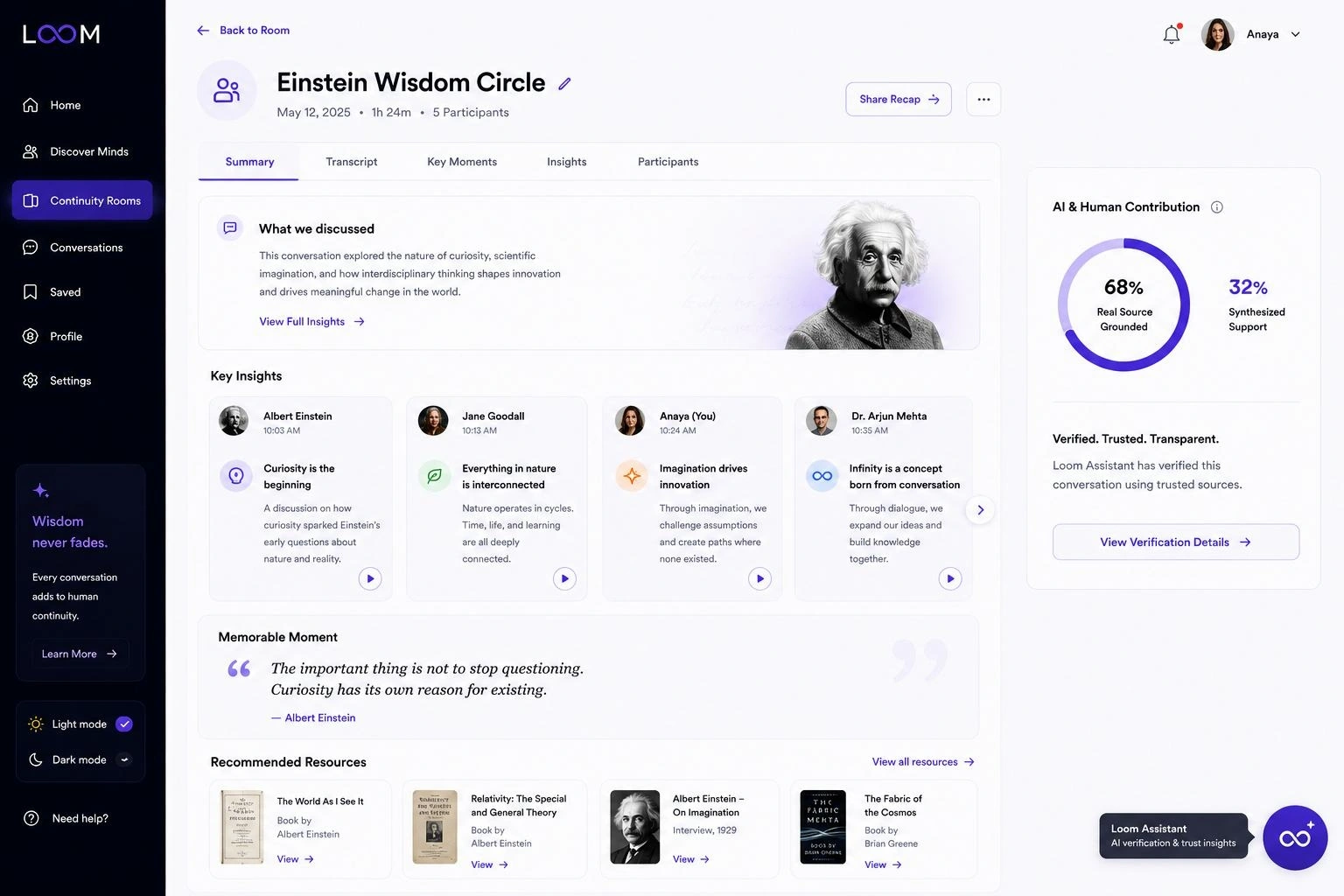
Design responseClearer sources and a distinction between original material and AI interaction.
A synthesis of documented qualitative feedback, connecting participant concerns to priorities for the next prototype test.
03 / THE DECISIONS
CLARITY, CONSENT, AND CONTROL
A research-informed sequence for the next prototype evaluation.
04 / THE REFLECTION
Participants found the concept relevant. Solo navigation offered a useful foundation, while group conversations revealed opportunities to clarify labels, steps, and conditions. Legacy Architects emphasized transparency and control. The team organized this qualitative feedback into semantic pairs to prioritize the next prototype revisions.
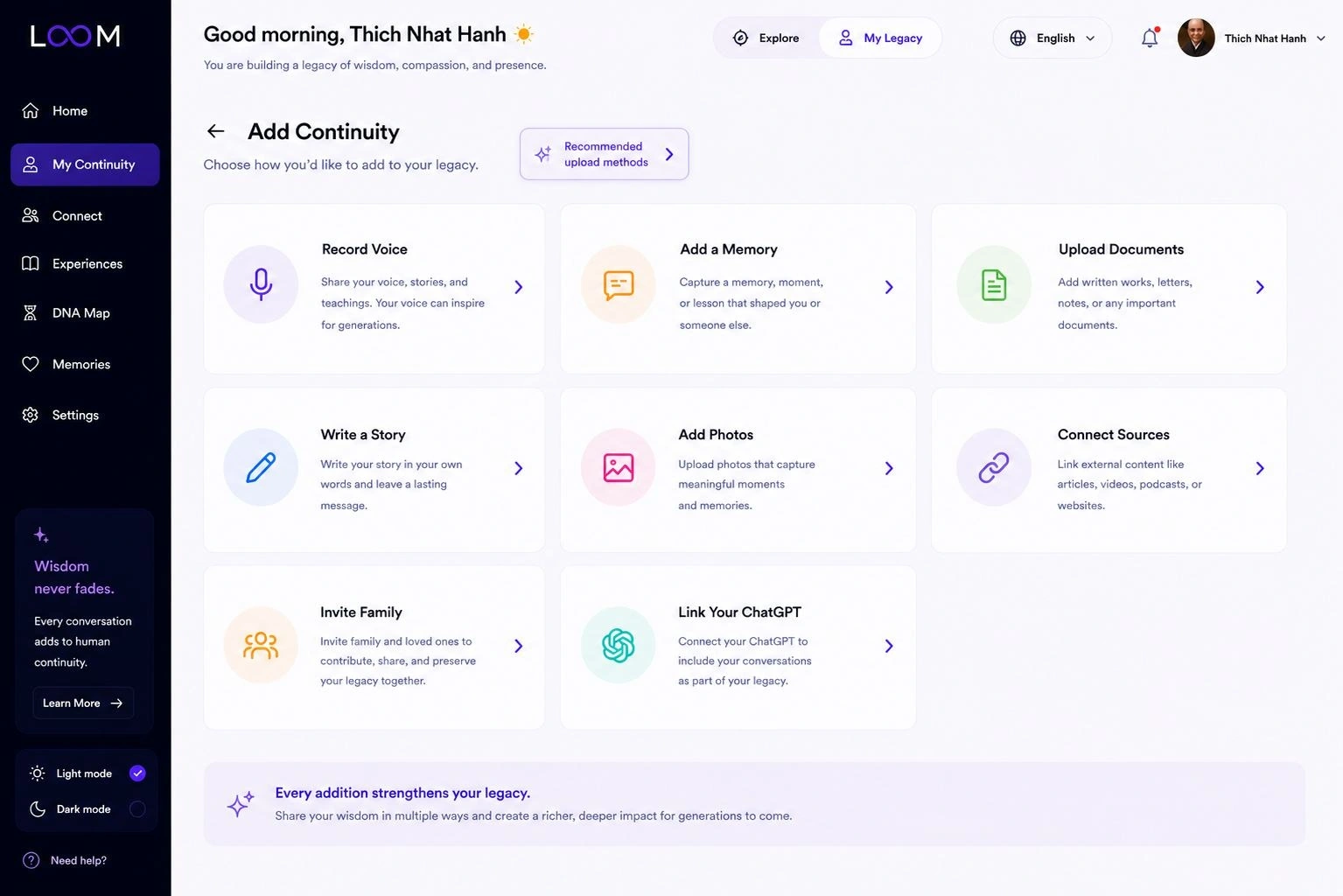
The revised screens introduced a homepage tutorial, multilingual access, clearer call scheduling, personal notes, more visible sharing and next steps, and contextual assistance. The report also reframed “credibility” as “authenticity,” emphasizing source clarity and a visible distinction between original material and AI-generated interactions.
Feedback expanded the concept beyond individual legacy toward shared family and cultural memory. It also prompted changes to customer segments and the proposed business model. These insights informed prototype revisions and an evolving business-model proposal. The scorecard sets targets for subsequent testing and development.
The next step is to test the revised group flow, consent controls, source transparency, and onboarding with participants over time. The report identifies naming confusion with the existing Loom product and recommends a new name before the next development phase.
05 / THE WORK
The ideas, interfaces, and tools that carry the work forward.
Source: DMGT 720 Loom, Part 4 (38-page user-testing presentation). “Loom” is the project’s working name; the report itself recommends changing it to avoid confusion with the existing product.
NEXT CASE STUDY / 06
Connecting a century-old banking brand with contemporary digital journeys, from goal-based discovery to starting an application.