CASE STUDY 04 / 2026 Show of Hands
Better meetings.Lasting momentum.
A meeting toolkit shaped with Waters Avenue stakeholders to carry decisions, participation, and trust from one meeting to the next.
Discover the story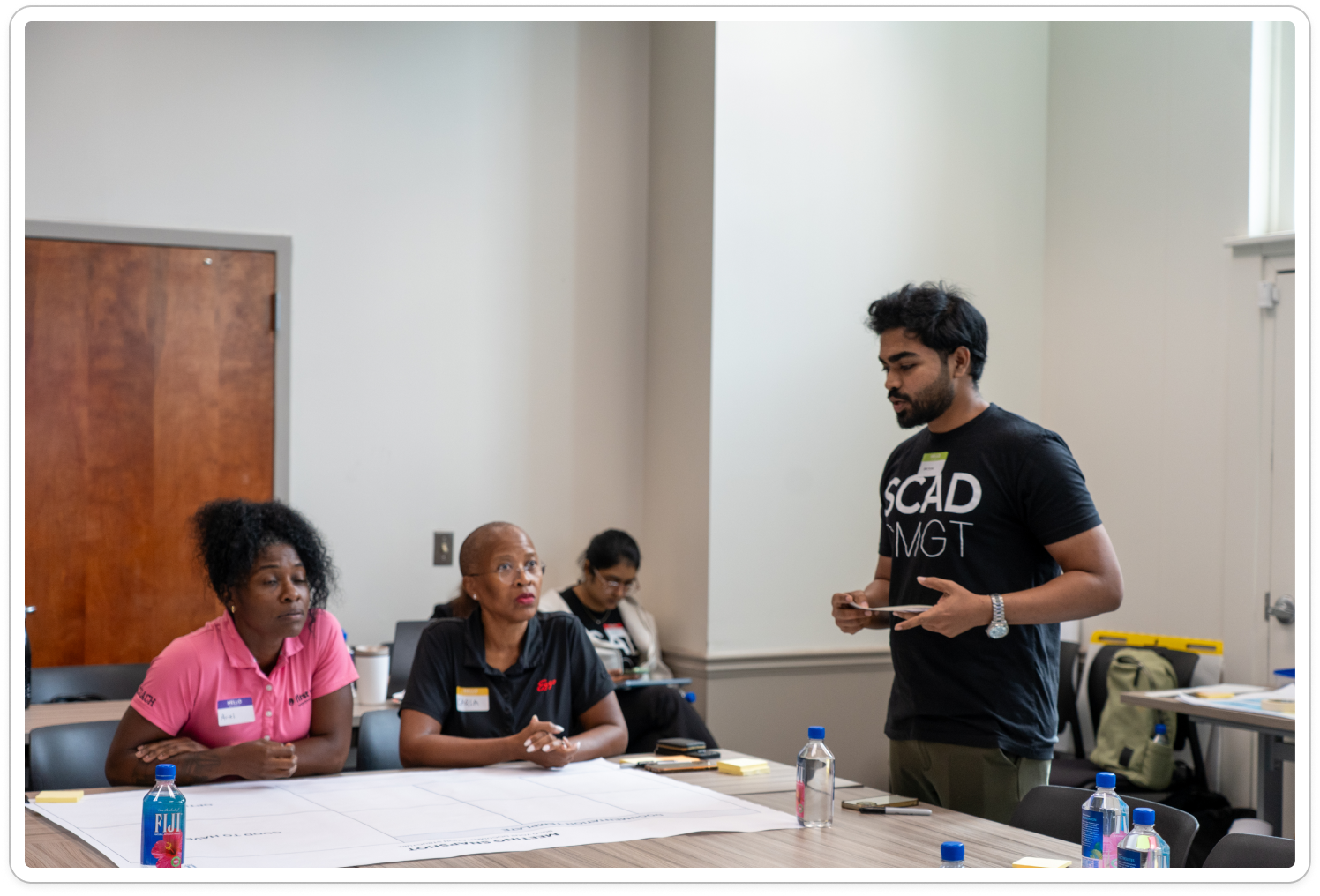 Show of Hands CO-DESIGN · FACILITATION · SERVICE DESIGN
Co-creation with the people closest to the problem. Arjun facilitating a community workshop.
01 / THE QUESTION
The gap between meetings
The Historic Waters Community Association already had relationships and local knowledge. The research pointed to a different problem: momentum and information were being lost between meetings. Busy business owners and solo operators could not always attend, while informal follow-through left decisions hard to trace.
SCAD × Historic Waters Community Association · Summer 2026 · Collaborative project · Prof. John Storey
Stakeholder audit · Diagnostic workshops · Co-creation · Toolkit design
Research collaborator and co-creation facilitator.SCAD team × HWCA · Prof. John Storey · Shared research and toolkit, building on preceding teams.
02 / THE RESEARCH
Shared problems.
A shared direction.
01 / UNDERSTAND THE RELATIONSHIPS
A corridor works
through its connections.
HWCA sits between people, businesses, and institutions. Select a relationship to see what each side brings.
Commercial stakeholders
Time, needs, and local implementation
Support, promotion, and connections
Participation had to work around the shop, the working day, and the people who could not leave either behind.
- Retailers & service providers
- Property owners & investors
- Education & childcare
Authority
Connect the right people to the right decision.
Capacity
Make participation fit real working lives.
Proof
Carry a shared record into the next action.
Stakeholder relationships and three operating gaps · Project Part 1, pp. 41–46. Simplified from the ERAF map.
02 / DESIGN THE CONVERSATION
Five activities.
Five ways into the problem.
The diagnostic workshop moved from perception to possibility to action. Explore the method and what it revealed.
15 min · Planned facilitation
If HWCA were a familiar object, what would it be—and why?
Make perceptions and assumptions easier to express.
- What emerged
- Metaphors described a trusted, supportive presence tied to community identity and local business.
- Design direction
- Carry that trust into the operating experience.
Prompts and planned timing: facilitation slides, 4–30. Findings: Project Part 2, pp. 3–8. Frameworks redrawn for this case study.
03 / THE DECISIONS
A meeting is a cycle.
Design the connections.
The toolkit connects preparation, participation, decisions, and follow-through. Move through the five stages to see how each makes the next possible.
ONE QUESTION. TWO WAYS TO ANSWER.
What is the biggest barrier
to opening on weekends?
Example pairing from the toolkit.
Preparation & Outreach
Bring the right questions into the room.
Pair a physical input channel with a digital one. Give each question a collector and a deadline so participation can begin before the meeting.
A shared agenda shaped by member input.
Meeting Toolkit, pp. 14–55 · Five-stage structure co-created in the workshop. Templates and examples redrawn for exploration.
CO-CREATION CHANGED THE DESIGN
Small corrections.
Meaningful differences.
The workshop made assumptions tangible enough to challenge—and practical enough to redesign.
Everyone can read ahead.
WHAT THE WORKSHOP MADE CLEARBusy owners may only have time to catch up once they arrive.
Build context into the opening.
Meeting Toolkit, pp. 24–29 · Research-to-design interpretations of the documented workshop learning.
04 / THE REFLECTION
What emerged.
What comes next.
The foundation connected the meeting experience to a larger question: how can a volunteer association sustain its mission? Two frameworks made that work explicit.
Protect the time people give.
Focused meetings with clear decisions.
Use timed agenda blocks, facilitation guidance, and a visible voting process.
Start / end punctuality · Variance from agenda time blocks
Measures are proposed evaluation criteria, not post-implementation results.
Foundation Document, pp. 137–144; Project Part 3, pp. 47–63. Four tracks connect objectives, goals, strategies, and measures.
Put the quick wins to work.
Use the directory and reusable templates to support outreach and follow-through.
Test one complete cycle.
Gather input, run the meeting, share decisions, and collect feedback.
Define the decision structure.
Resolve membership, voting, dues, and leadership as the organizational direction becomes clear.
Implementation pathway · Project Part 3, pp. 109–112.
05 / THE WORK
A closer look.
The ideas, interfaces, and tools that carry the work forward.
THE MEETING TOOLKIT
From the workshop.
Into your hands.
Explore the complete Show of Hands toolkit: five meeting stages, worked examples, and the templates that carry decisions forward.
74 pages · Original artwork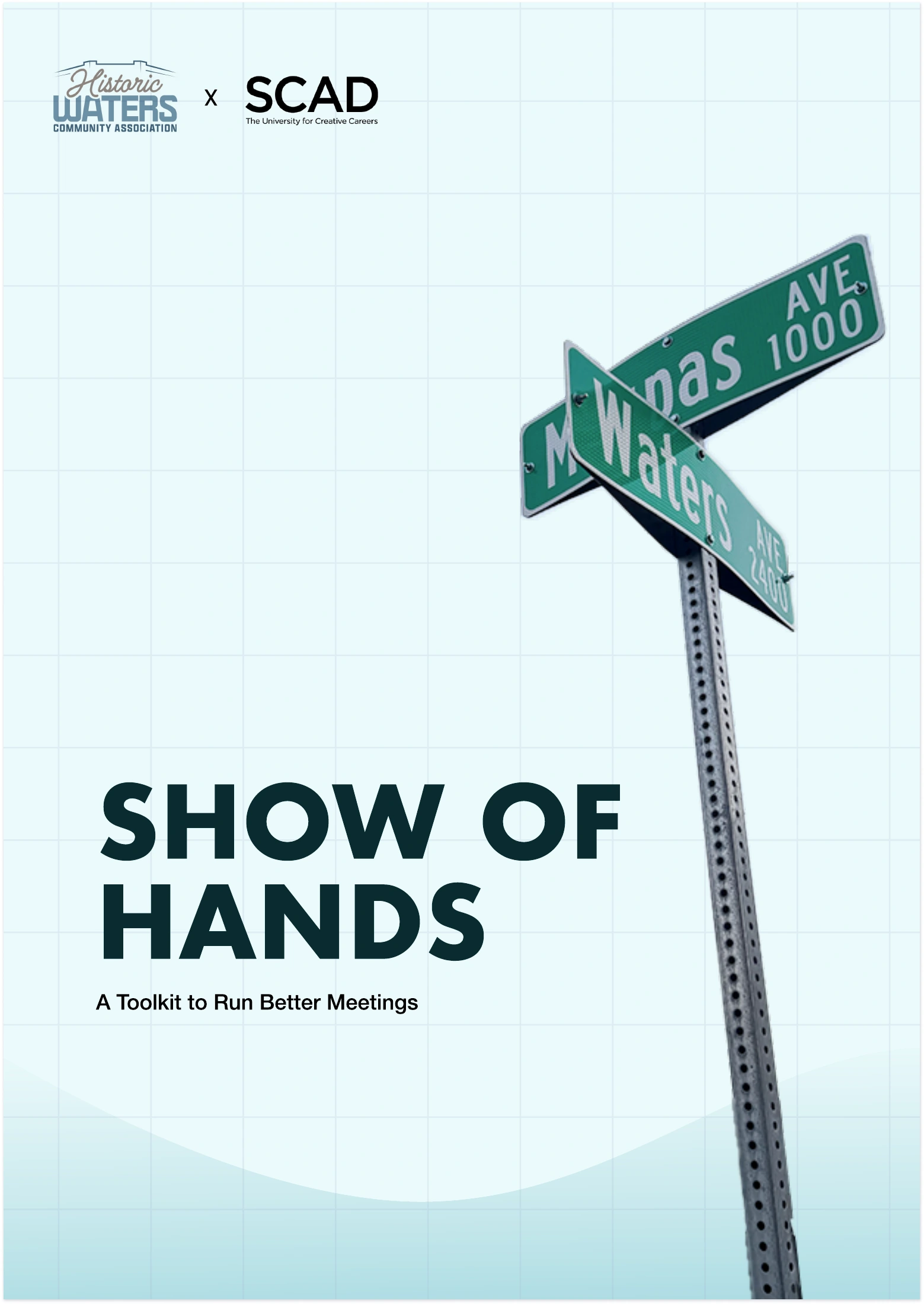
Click to turn · Swipe on mobile · Arrow keys when focusedFront cover · Show of Hands
START WITH THREE TOOLS
A small system.
Ready to use.
The toolkit’s starter set makes participation, responsibility, and feedback visible in one meeting cycle.
- 01
Real-Time Directory
Who is in the room?
Name · Business or role · Contact · First meeting - 02
Action Plan & Decision Record
What happens after we leave?
Task · Sign-off · Responsible · Consulted · Informed · Timeline - 03
Feedback Card
What did we miss?
What worked · What could improve · What was not said
TRY THE CONTRIBUTION MENU
“I can help.”
At a scale that fits.
Replace an open-ended request with a task, a time commitment, and a clear level of involvement.
Meeting Toolkit, p. 12 and pp. 45–46. Displayed tasks are toolkit examples, not completed volunteer commitments.
Sources: DMGT 732 Project Parts 1–3, Foundation Document, Meeting Toolkit, CCW presentation, and workshop facilitation slides. Research and tools developed collaboratively with the SCAD team and Waters Avenue stakeholders.
NEXT CASE STUDY / 05
Loom
Testing a digital-continuity concept to understand how clarity, consent, and authenticity shape trust.